CERN: ALICE observes for the first time one of the signals of primordial matter in proton collisions
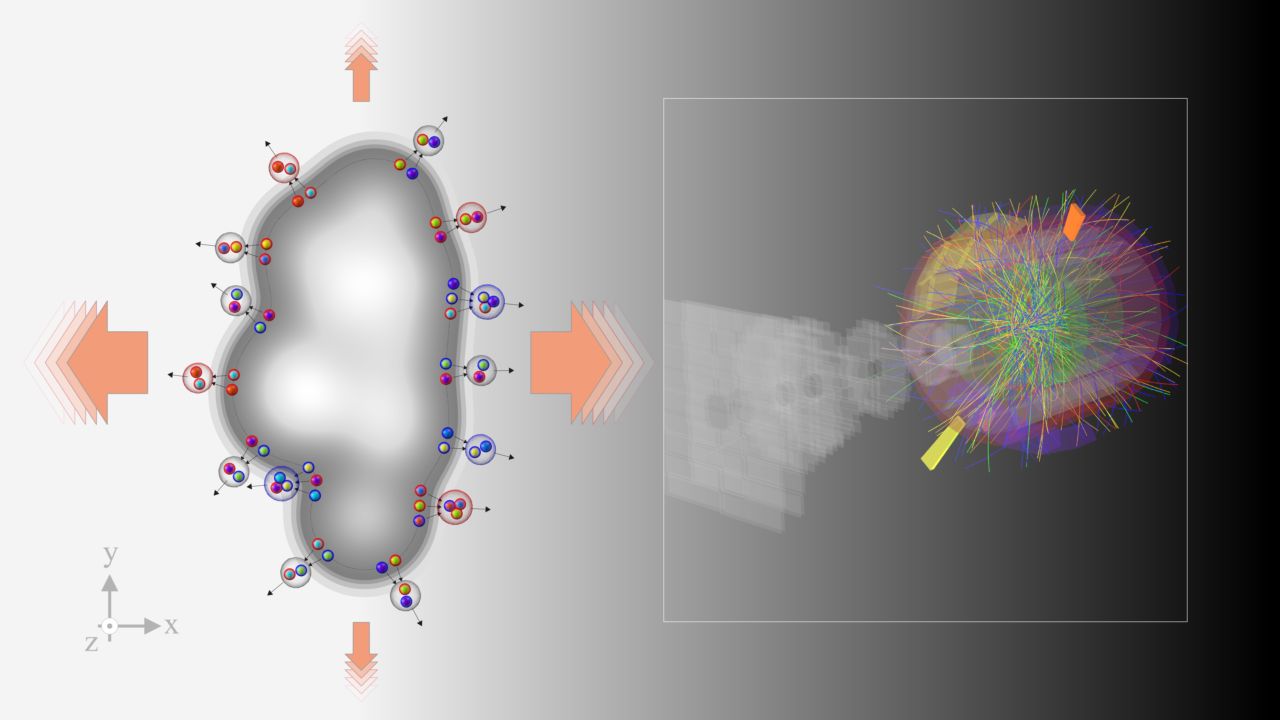
The ALICE experiment at the CERN LHC accelerator has observed for the first time, in proton-proton and proton-nucleus collisions, an effect typically associated with the quark–gluon plasma (QGP), the primordial state that characterised matter a few millionths of a second after the Big Bang. Until now, it was believed that this effect – known as anisotropic flow, in which the particles produced in a collision are not distributed uniformly but show preferred directions – could only be created in heavy-ion collisions, such as lead-lead ones, but ALICE has observed the emergence of a sort of “collective flow” of quarks also in proton collisions. The result was published today, 20 March 2026, in an article in Nature Communications, where the ALICE collaboration, which also includes the INFN National Institute for Nuclear Physics, describes how the collective behaviour observed in collisions of small systems, those of protons, originates at the quark level and is transmitted to composite particles (hadrons, such as protons and neutrons) through the mechanism of quark coalescence, in which nearby quarks moving collectively combine to form hadrons.
Protons and neutrons are composed of fundamental elements called quarks and gluons, collectively known as partons, which at ordinary temperatures remain confined within hadrons, as described by quantum chromodynamics (QCD), the theory that explains the strong nuclear interaction. However, in extremely hot and dense environments, quarks and gluons can temporarily become free in a deconfined state called quark–gluon plasma. This state, which constituted the universe a few microseconds after the Big Bang, is recreated for infinitesimal fractions of a second at the CERN LHC accelerator by colliding heavy nuclei, such as lead nuclei. Since the early years of the LHC experimental programme, though, some of the signals of the QGP have been observed, quite unexpectedly, also in proton collisions, in which it was believed that the conditions necessary to form an expanding system of quarks could not be achieved. Among these signals, which emerge gradually as the number of particles produced in the collision increases, stand out the abundance of “strange” quarks and the long-range collective behaviour of the produced particles. These unexpected observations have raised the fundamental question of whether there exists a “threshold”, in terms of system size, for the production of the QGP, or whether very small “droplets” of this form of matter are also formed in proton collisions.
A key signal of the formation of the quark–gluon plasma is the so-called anisotropic flow, in which the particles produced in a collision are not distributed uniformly but show preferred directions, determined by the geometry of the collision and the pressure profile. The ALICE collaboration has measured the anisotropic flow of mesons (charged pions, kaons, neutral kaons), which contain two quarks, and baryons (protons, lambda baryons), which contain three quarks, in proton-proton and proton-nucleus collisions. For the first time, ALICE measurements show a difference in behaviour between the flow of baryons and that of mesons in proton-proton and proton-lead collisions, particularly in collisions that produce a very high number of particles.
Physical simulations that incorporate the anisotropic flow of quarks and their subsequent coalescence into new particles successfully explain the most recent results of the ALICE experiment. By contrast, models that exclude one of the two components fail to reproduce the observations.
“The current measurements, together with comparisons with state-of-the-art theoretical calculations, provide evidence that the system created in proton-proton and proton-lead collisions with a high number of produced particles includes a phase in which a collective flow of quarks briefly develops, similar to that observed in heavy-ion collisions”, comments Andrea Dainese, researcher at the INFN Padua division and deputy coordinator of the ALICE collaboration. “At the same time, these measurements highlight the limits of current theoretical models. Although calculations that include quark coalescence qualitatively describe the observations, quantitative discrepancies with ALICE data remain, largely due to uncertainties in modelling the substructure of the proton and its fluctuations”, concludes Dainese.
Collisions of oxygen nuclei recorded during a short run in 2025 will provide further important information, since they produce final states with similar particle multiplicities but present better-controlled initial conditions compared to proton-induced collisions.